
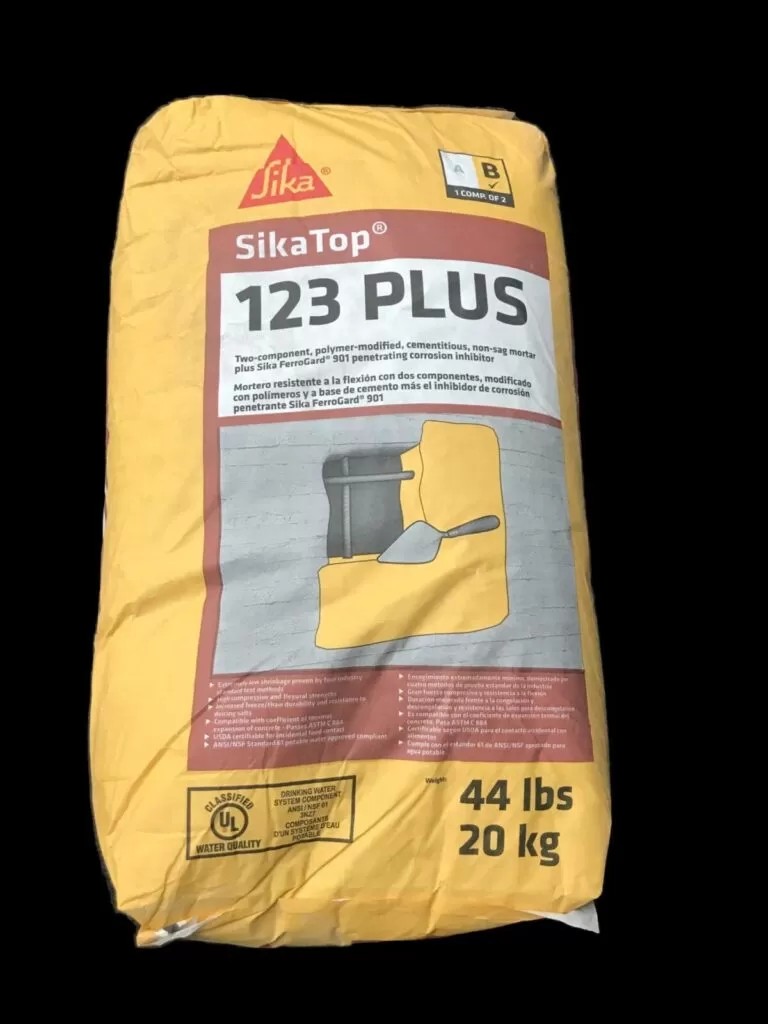
Sikatop 123 Plus: Two-Component Penetration Inhibitor
$58.65
- Two-component concrete repair mortar
- Made for vertical and overhead repairs
- Fast-setting and non-sag
- High compressive and flexural strength
- Very low shrinkage
- Contains corrosion inhibitor for added steel protection
- Resists freeze/thaw cycles and deicing salts
Part A: Safety Data Sheet
Part B: Safety Data Sheet
954 in stock
Checkout stays fast. After purchase, set up a Metro reorder account to keep your order history together and make repeat orders easier.
Sikatop 123 Plus: Two-Component Penetration Inhibitor
SikaTop 123 Plus is a two-component, polymermodified, Portland cement-based, fast-setting, non-sag mortar. It is a high performance repair mortar for vertical and overhead surfaces and offers the additional benefit of Sika FerroGard® 901, a penetrating corrosion inhibitor included in its formulation. Questions about Sikatop 123 Plus? Contact Us.
SikaTop 123 Plus is a two-component, polymer-modified repair mortar made for vertical and overhead concrete repairs. It is a fast-setting, non-sag material that can be used on concrete and mortar above grade, below grade, or on grade. It is a good fit for repairs in parking structures, industrial plants, walkways, bridges, tunnels, dams, ramps, and other areas where a strong repair mortar is needed.
The formula includes Sika FerroGard 901 corrosion inhibitor, which helps reduce corrosion of reinforcing steel in the repaired area and even in nearby concrete. SikaTop-123 Plus is also designed for very low shrinkage, high compressive and flexural strength, and improved resistance to freeze/thaw cycles and deicing salts.
This mortar develops strength quickly, reaching about 3,000 psi after one day, 4,000 psi after seven days, and 6,000 psi after 28 days under the listed test conditions. It can be placed from 1/8 inch up to 1-1/2 inches thick per lift, and multiple lifts can be used when deeper repairs are needed.
SikaTop-123 Plus is mixed by combining the liquid Component A with the powder Component B using a low-speed drill and mixing paddle. Once mixed, the mortar is scrubbed into the prepared surface to fill pores and voids, then packed into the repair area and finished as needed. Its non-sag consistency helps the material stay in place on vertical and overhead surfaces during installation.
The product is also designed to stand up to demanding concrete repair conditions. Testing shows strong freeze/thaw durability, low cracking potential, and low chloride permeability, helping protect repaired concrete in areas exposed to weather and road salts. It is also approved for potable water applications under ANSI/NSF Standard 61.
USES:
On grade, above and below grade on concrete and mortar.
▪ On vertical and overhead surfaces. As a structural repair material for parking structures, industrial plants, walkways, bridges, tunnels, dams and ramps.
▪ Approved for repairs over cathodic protection systems
Surface preparation:
Surface must be clean and sound. Remove all deteriorated concrete, dirt, oil, grease, and other bond-inhibiting materials from the area to be repaired.
▪ Be sure repair area is not less than 1/8″ (3 mm) in depth.
▪ Preparation work should be done by high pressure water blast, scabbler or other appropriate mechanical means to obtain an exposed aggregate surface profile of ±1/16″ (1.6 mm) (CSP-5).
▪ To ensure optimum repair results, the effectiveness of decontamination and preparation should be assessed by a pull-off test.
▪ Saw cutting of edges is preferred and a dovetail is recommended.
▪ Substrate should be Saturated Surface Dry (SSD) with clean water prior to application. No standing water should remain during application.
Priming:
Reinforcing steel: Steel reinforcement should be thoroughly prepared by mechanical cleaning to remove all traces of rust. Where corrosion has occurred due to the presence of chlorides, the steel should be high pressure washed with clean water after mechanical cleaning. For priming of reinforcing steel use Sika®Armatec® 110 EpoCem (consult PDS).
Concrete Substrate: Prime the prepared substrate with a brush or sprayed applied coat of Sika® Armatec® 110
EpoCem (consult PDS).Alternately, a scrub coat of SikaTop 123 Plus can be applied prior to placement of the mortar. The repair mortar has to be applied into the wet scrub coat before it dries.
MIXING:
▪ Pour Component ‘A’ into mixing container.
▪ Add Component ‘B’ while mixing continuously. Mix mechanically with a low-speed drill (400–600 rpm) and mixing paddle or mortar mixer.
▪ Mix to a uniform consistency, maximum 3 minutes. Manual mixing can be tolerated only for less than a full unit. Thorough mixing and proper proportioning of the two components is necessary.
| Weight | 51 lbs |
|---|---|
| Dimensions | 20 × 12 × 4 in |